
Nonogram Games
Nonogram games — also called picross or picture cross — give you numbers along every row and column, then ask you to fill the matching runs of squares. There is no guessing: each filled cell is forced by the clues, and a pixel picture appears as the grid fills in. This page collects three free browser versions that run without a download or an account. 3 games are playable now.
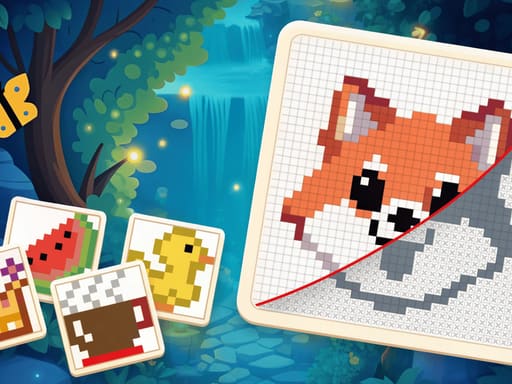
The black-and-white anchor: read the row and column numbers, mark filled and empty cells, and reveal a pixel picture without guessing.
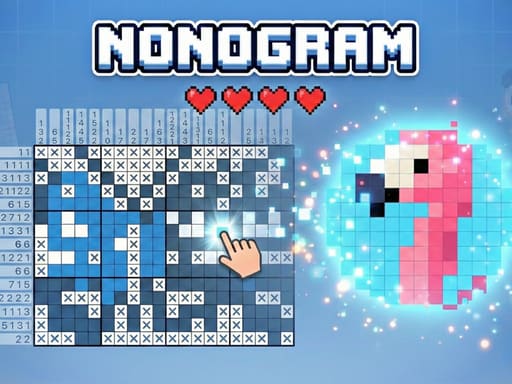
Nonogram
The intent-word pick: the classic picture-cross rules — consecutive filled runs with at least one gap between groups — across a large griddler library.
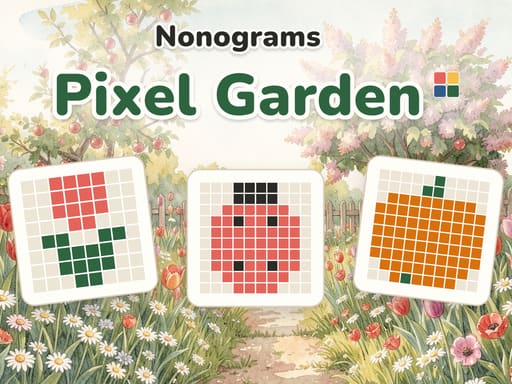
Nonograms: Pixel Garden
The colour variation: every clue run has a colour, 168 pictures span 5×5 to 30×30, and a fresh daily 10×10 board is the only true daily update among the three.


The shelf splits into three honest styles. Grid Odyssey: Nonograms is the black-and-white anchor, built around reading row and column clues and marking filled and empty cells. Nonogram is the direct picture-cross pick, the member whose source promises a vast griddler library under the classic consecutive-run rules. Nonograms: Pixel Garden adds colour: each number run carries a colour, the pictures grow across a garden map, and one free 10×10 board refreshes daily.
Every member is cataloged for desktop and mobile and uses portrait orientation, and each game page states its controls, difficulty and session estimate before you press Play. If you want pure daily logic in other shapes, the daily puzzle collection is the broader neighbour; for sliding-tile and spatial logic, the logic collection is the wider category.
At a glance
Scroll the table sideways to see every column →
| Game | Difficulty | Typical session | Devices |
|---|---|---|---|
| Grid Odyssey: Nonograms | Easy | ~6 min | desktop + mobile |
| Nonogram | Easy | ~7 min | desktop + mobile |
| Nonograms: Pixel Garden | Easy | ~8 min | desktop + mobile |
About Nonogram Games
What nonogram games are
A nonogram is a logic puzzle where the numbers beside each row and column describe the runs of filled cells in that line. A clue like 3 1 means three adjacent filled cells, then at least one empty cell, then one more filled cell; nothing tells you where the run starts, so you narrow the position from both ends. The filled grid eventually forms a pixel picture, which is why the same puzzle is sold as picross, picture cross, griddler and paint-by-numbers in different places.
The defining rule is that every cell is forced. There is no timer to beat and no penalty for thinking, so a correct line is one you can prove from the clues you already have rather than one you guessed and hoped for. That makes the genre unusually forgiving for a puzzle: a stuck player can always step back, re-count a line and find the cell that was certain all along.
All three members of this shelf run that same loop in the browser with no download and no account. What changes between them is the palette, the picture set and how much help the interface gives you on a large grid, which is the honest basis for choosing one over the others.
The black-and-white pair: Grid Odyssey and Nonogram
Grid Odyssey: Nonograms is the straight black-and-white entry. The controls describe a two-state cell: you mark a square as filled or as a cross, then use the row and column numbers to deduce which cells belong to the picture. Because the puzzle never asks you to colour a cell, the whole session is clue arithmetic — count the runs, find the overlap, mark the empties — which is the cleanest way to learn the genre if you have never played one.
Nonogram is the member whose source explicitly promises a vast collection of griddlers, and it keeps the classic picture-cross rule set: fill the matching consecutive squares and leave at least one gap between separate groups until the picture appears. Where Grid Odyssey frames the loop around careful deduction, Nonogram frames it around volume — the same rules applied across a large library, so a player who finishes one picture can move straight into the next without relearning anything.
Read together, the pair covers two reasons people open a nonogram: Grid Odyssey for the satisfaction of a clean, uncoloured deduction, and Nonogram for the sense that there is always another grid waiting. Both are cataloged as Easy, both use portrait orientation, and both give mobile players the same tap-first controls as desktop mice.
The colour variation: Nonograms: Pixel Garden
Nonograms: Pixel Garden keeps the clue system but adds colour. Each number run carries its own colour, so a line can hold several differently coloured groups and the solver has to track both the count and the paint. The source describes the result as a picture growing from the cells you filled and settling into a garden bed, and it puts the picture set at 168 images from 5×5 to 30×30 across 14 garden corners, plus a fresh daily 10×10 board.
That daily 10×10 is the honest reason Pixel Garden stands apart on this page: it is the only member whose source describes a board that changes on a daily cycle, so it is the one to open if you want a short recurring puzzle rather than a long library. The larger grids also bring the interface aids the other two do not advertise — high-contrast numbers, a zoomed-in view when a big puzzle opens, and a whole-field toggle so you can check the picture without losing your place.
The trade is that colour adds a second layer of bookkeeping. A player still learning to read runs may find the black-and-white pair easier to start with; a player who already reads clues comfortably will appreciate that the colours let each line carry more information per glance. Pixel Garden is still cataloged Easy and still portrait on desktop and mobile, so the difference is in the puzzle, not in the access.
Choosing, devices and honest caveats
Choose by the session you want. For a clean black-and-white deduction with a two-state cell, start with Grid Odyssey: Nonograms. For the classic picture-cross rules across a large griddler library, choose Nonogram. For colour clues, a garden of pictures and a daily board, choose Nonograms: Pixel Garden. If the appeal is logic in a different shape, the logic collection is the broader neighbour, and the daily puzzle collection is the closest pick for players who want a short recurring task rather than a library.
On devices, all three are cataloged for desktop and mobile and all three use portrait orientation. Controls are touch-first — tap or drag cells, mark empties, and zoom or pan on the larger grids — so a phone or tablet works without a keyboard. None of the three needs an account or a download. The catalog lists estimated sessions of six, seven and eight minutes respectively, which fits the genre's short-break shape rather than a long campaign sitting.
Two honest notes apply to the whole shelf. All three carry a 16+ age label in the catalog, so the picture-puzzle theme should not be read as a children's rating; parents should check each game page and the provider's content note. And all three are third-party embeds, so the usual accessibility caveat applies — keyboard navigation, screen-reader labels, pause behavior and reduced-motion settings may not be exposed by the provider's build. Every game page lists its controls, orientation and session estimate before Play, and the whole shelf is free with no download and no account.
Frequently asked questions
Are these nonogram games free and playable without a download?
Yes. Every game on this page runs free in the browser on desktop and mobile, with no download and no account. Progress stays inside the game session or the provider's own save, so closing the tab ends that round unless the game saves it.
What is the difference between nonogram, picross and picture cross?
They are different names for the same puzzle type: numbers beside each row and column tell you how many consecutive cells to fill, and the filled grid forms a picture. Picross is the Nintendo-era name and picture cross is the newspaper-style name; the rules are the same.
Which nonogram should I start with?
Start with Grid Odyssey: Nonograms for a straight black-and-white set, or Nonogram if you want the plainest picture-cross rules. Choose Nonograms: Pixel Garden when you want colour clues and a daily board; it is the only member here with a true daily puzzle.
Do these nonogram games work on a phone?
All three are cataloged for desktop and mobile and all three use portrait orientation. Controls are touch-first — tap or drag cells, with zoom and pan on larger grids — so a phone or tablet works without a keyboard.